

Is a Learning Tower Worth It? What We Learned Building One for Our Own Toddler
If you have a toddler, you probably know the kitchen chair move. You start cooking, and a minute later you hear a chair scraping across the floor. Then there's a small person standing on it, leaning over the counter to see what you're doing.
That was Halle. She wanted to be part of everything happening in the kitchen, and a grown-up chair was the only way she could get there.
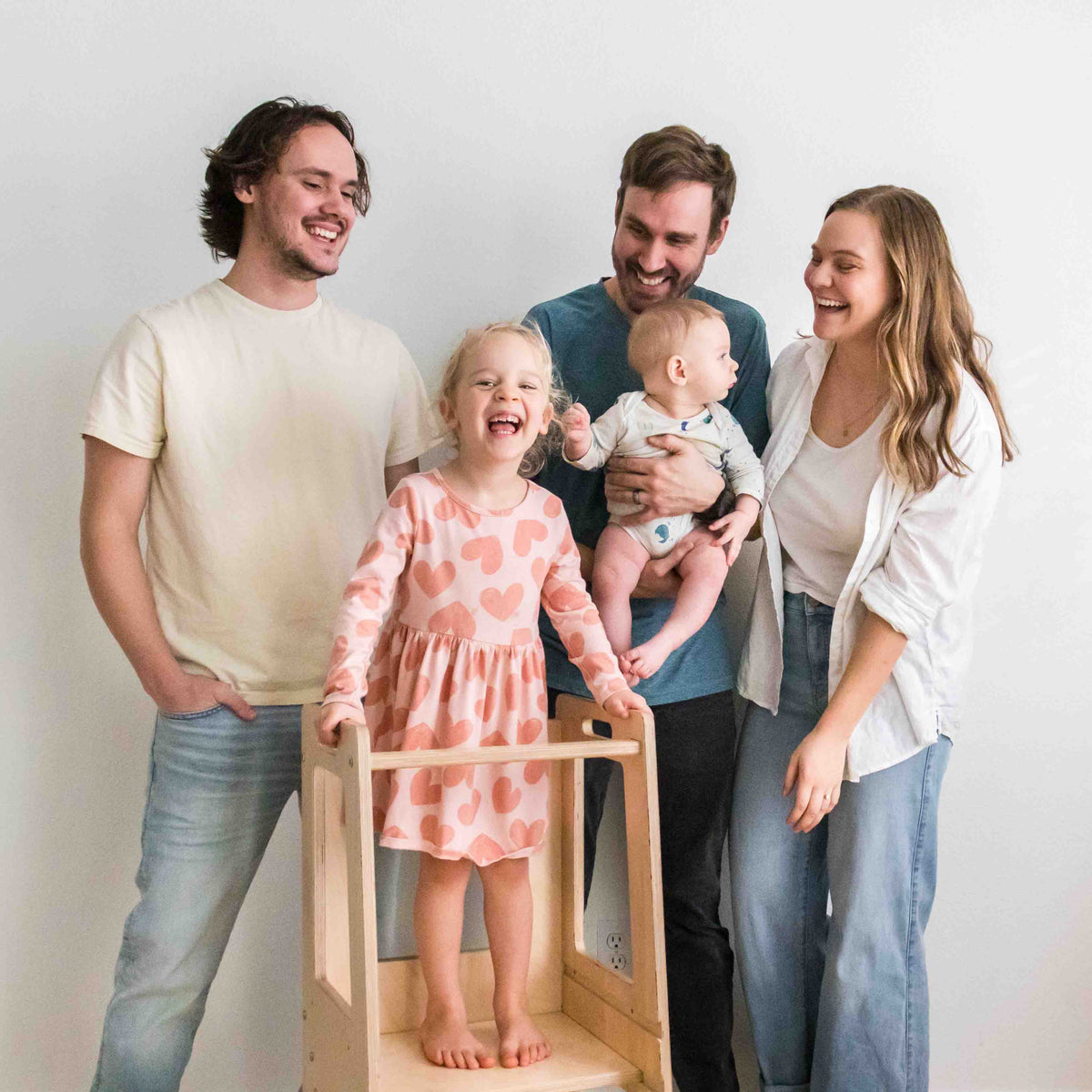
By then, David and Matt had already decided to start a business building kids furniture, and they had bought a CNC machine to make it happen. Halle, and a better life for both of their families, were the biggest reasons why. So when Halle needed a learning tower, we didn't buy one. We designed and built our own, and it ended up being the very first product Halle's Corner ever made.
So, is a learning tower worth it?
Our honest answer is yes. And we mean the idea in general, not just ours.
A step stool is great for reaching the sink. But toddlers aren't always paying attention to where their feet are, especially when there's pancake batter in front of them. A learning tower puts a railing around them, so they can focus on the job instead of the edge of a stool.
It also changes the whole feel of cooking together. Your toddler gets to stand at counter height and actually help, and you get your hands back. You can focus on what you're making instead of holding a kid on your hip or watching a wobbly chair.
How we designed ours (three tries and a few months)
We didn't get it right the first time. We designed and cut three full versions before we landed on the tower we sell today, and the whole thing took us months.

From the start, we picked durability over fashion. We wanted something strong enough to hold up to everything a toddler puts it through: climbing in, climbing out, scooting it across the kitchen, and all the wiggling that comes with it.
Version one looked a lot like the tower we sell today, just bigger in every direction: taller, wider and deeper. It also had a longer, even slope on the front, where your child climbs in, that angled out wide at the bottom, and only one platform height, so it couldn't grow with your child. It worked, but it was bulky, took up too much of the kitchen, and didn't fit well in our material. That last part matters more than it sounds. We try to waste as little as possible, and a design that leaves a pile of scraps behind just doesn't sit right with us.

Version two had an added base extension, a board along the bottom that stuck out past the frame. It looked good, but it wasn't ideal. More on that one below.
Version three is the one we kept. It's smaller in every direction than version one, so it looks better and fits better in a home. It has full back support for stability, and two platform heights (15" and 18") so it can grow with your child. We landed on those heights after a lot of research and a lot of testing with Halle and her cousins.

The tower also decided how we build everything else. While we were working on it, we tested different woods, finishes and hardware. What won is what we still use on every piece: furniture-grade Baltic birch, hand-sanded rounded edges, a water-based top coat, and recessed hardware.
From the Workshop: The Base Extension We Scrapped
On version two, we added an extension to the base: a board along the bottom that stuck out past the frame. The idea was to make the tower harder to tip over. In real life, all it did was catch toes. Every one of us stubbed a foot on it, and it still didn't make the tower tip-proof.

So we dropped the extension and put our effort where it actually helped: a sturdy frame and full back support. The tower we ended up with is solid, and it holds steady through a lot of everyday toddler wiggling. We just won't call it tip-proof, because honestly, most learning towers, ours included, aren't. Halle knows to stand in the middle and not lean over the edges, and a grown-up always stays close by.
What Halle actually does in it
Halle loves being part of cooking. She helps make pancakes and waffles, and honestly just about anything else we're making. She cuts up fruit and vegetables for snacks and dinner, using her own toddler knife (not a real one) with a grown-up right beside her.
She also scoots the tower around on her own, over to the sink to wash her hands or rinse fruit, or to the pantry to grab what she needs. We knew it wouldn't stay put for long, and honestly, that's a nice bonus.

And when other kids come over, the tower is the first thing they go for. They either fight over it or figure out how to share it. We count both as learning experiences.
Learning tower or step stool: which one do you need?
It depends on the job.
| Step stool | Learning tower | |
|---|---|---|
| Best for | Quick reaches: washing hands, brushing teeth, grabbing a cup | Longer jobs at the counter: stirring, pouring, cutting, watching you cook |
| Railing around your child | No | Yes |
| Space it takes | Small, easy to tuck away | More floor space; ours doesn't fold |
| Where it lives | Bathroom or wherever it's needed | Usually one spot, like a kitchen island |
A learning tower might not be the right fit if your kitchen is very tight and you'd need to fold it away after every use. Ours doesn't fold. It takes up less room than our first version did, but it does need a spot. At our house, it sits at the kitchen island and stays there, unless Halle decides to drag it somewhere else.
Whichever you choose, a grown-up should always be right there while your child is standing on either one.
Tips for using a learning tower at home
These work with any tower, not just ours.
- Push it flush against the counter before your child climbs in, so there's no gap between the platform and the counter edge.
- Pick a spot away from the stove. Set the tower up where your child can help with prep, not next to hot burners or pans.
- Adjust the platform as they grow. Most towers have more than one height. When the counter hits around your child's belly, they can work comfortably without reaching up.
- Teach "feet in the middle." Standing in the center and not leaning over the sides is a simple rule even young toddlers can learn.
- Let them climb in and out on their own. That's half the fun for them, and it's where a lot of the independence comes from.
- Give them a real job. Washing strawberries, stirring pancake batter, tearing lettuce or cracking an egg into a bowl. Kids can tell the difference between helping and being kept busy.
What other parents say
The families who've bought our tower mostly mention the same few things: it was easy to put together, it's sturdy, and their kids use it every day. You can read their reviews on the Toddler Tower page.
Halle's verdict: She loves it. Ask her and she'll tell you herself, probably while standing in it.
If you're ready to bring your little helper up to the counter, take a look at our Toddler Tower. And if you're new here, meet the family behind Halle's Corner.
Thanks for stopping by. From our family to yours,
Halle's Corner